Hair
Hair transplant in San Salvador
An outpatient surgical procedure that moves your own hair from the back of the head to areas of permanent hair loss. Dr. Leana Quintanilla performs it at her clinic using the FUT and FUE techniques, for men and women.
What is a hair transplant?
It is a surgery in which hair follicles are taken from a donor area — usually the back and sides of the head, where hair tends to last a lifetime — and placed one by one, in small units, in areas with little or no hair. Because the transplanted hair keeps the characteristics of the donor area, it tends to stay in its new location.
Dr. Leana Quintanilla trained in hair transplantation in Santo Domingo, Dominican Republic, and has kept up to date in hair restoration and trichology.
Who is it for?
- Men and women with stable androgenetic alopecia (hereditary hair loss) and areas of permanent loss.
- People with bald areas caused by scars from surgery, burns or accidents on the scalp.
- People with a sufficient donor area.
It is not always the first option. If hair loss is active, it is first treated with medicines or other therapies to stabilize it. Some alopecias, such as active alopecia areata or inflammatory alopecias, are not treated with a transplant. That is why everything starts with a hair loss assessment.
What is the procedure like?
- Assessment beforehand: diagnosis of the cause of hair loss, examination of the donor area, lab tests and design of the area to be treated.
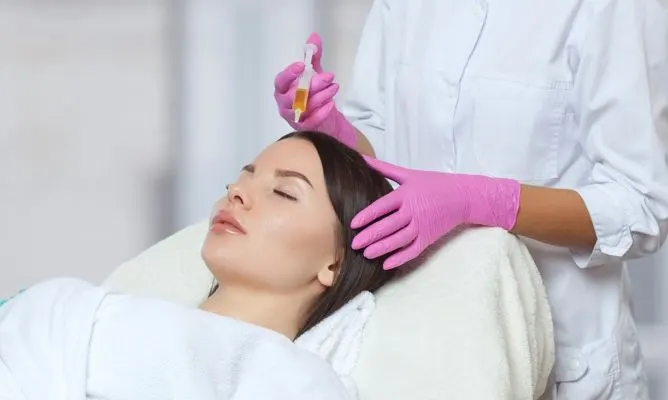
- On the day of the procedure: it is done at the clinic under local anesthesia and does not require a hospital stay. Follicular units are taken from the donor area and placed in the recipient area. It can take several hours, depending on the number of grafts.
- Recovery: the patient goes home the same day with clear instructions on washing and aftercare.
Techniques we use: FUT and FUE
Dr. Quintanilla performs hair transplants in her clinic's procedure room, using the two main techniques:
FUT (strip harvesting)
A thin strip of scalp is removed from the donor area and the follicular units are separated from it under magnification. The area is closed with stitches and leaves a fine linear scar that is covered by the hair. It allows a high number of grafts to be obtained in a single session.
FUE (follicular unit extraction)
Follicular units are extracted one by one with a very fine-tipped instrument. It does not leave a linear scar, only small, barely visible dot-like marks, so it is useful for people who wear their hair short.
Which is best for you?
The technique is chosen at the assessment based on the quality and size of your donor area, how much hair is needed, how long you wear your hair and your preference. In some cases they can be combined.
Recovery and results
- In the first few days there may be mild swelling and small scabs in the treated areas.
- It is normal for the transplanted hair to fall out 2 to 6 weeks afterwards; the follicle remains and produces hair again.
- New growth starts to show from 3 or 4 months, and the result is assessed at around 12 months.
- Not smoking and following the washing and aftercare instructions help the grafts take.
- Medical treatment usually continues after the transplant to protect the original hair that has not yet fallen out.
Frequently asked questions
Is a hair transplant permanent?
The transplanted hair tends to stay because it comes from an area that resists hair loss. However, the original hair may keep falling out, so it is usually combined with medical treatment.
What is the difference between FUE and FUT?
In FUT, a thin strip is removed from the donor area, leaving a fine linear scar hidden by the hair. In FUE, follicles are extracted one by one, leaving barely visible dot-like marks. The doctor will recommend the most suitable technique at the assessment.
Where is the procedure done?
At Dr. Leana Quintanilla Dermatology in Colonia Escalón, San Salvador. It is an outpatient procedure: you go home the same day.
Does it hurt?
It is done under local anesthesia. Afterwards there may be mild discomfort, which is controlled with pain relievers.
Can women have a hair transplant?
Yes, in selected cases. In women it is especially important to find the cause of the hair loss before recommending it.
How many days off will I need?
It does not require a hospital stay. Most people return to light activities within a few days; the doctor will give you aftercare instructions and tell you when you can exercise again.
Will it look like a transplant?
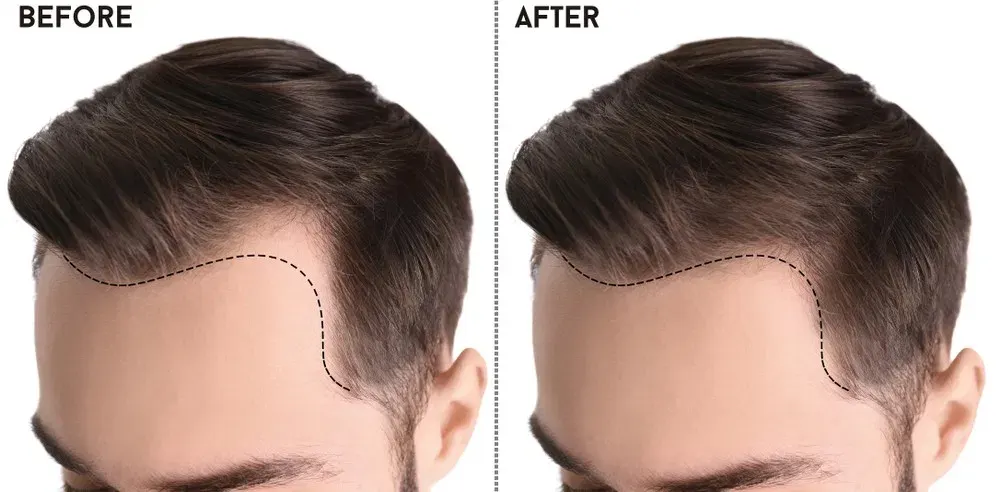
The goal is a natural-looking result, following the direction of your hair and with a hairline that suits your age.